Title: brake help
Post by: Dorianfes on August 04, 2004, 11:22:59 AM
Post by: Dorianfes on August 04, 2004, 11:22:59 AM
need some help with my brakes. i think all i need to do is top off the brake fluid. but i was wondering what type of brake fluid the gs takes. also would i need to bleed the brakes? is this necessary?
Title: brake help
Post by: goat on August 04, 2004, 11:55:47 AM
Post by: goat on August 04, 2004, 11:55:47 AM
the suggested brake fluid is DOT4. You can get it at any auto parts store.
As far as bleeding goes, that depends on what is going on and what you are planning on doing. If your brakes are just a little low, then all you need to do is add fluid and you're good to go.
If there is already air in the line or if you take anything in the line apart, then yes, you need to bleed them.
As far as bleeding goes, that depends on what is going on and what you are planning on doing. If your brakes are just a little low, then all you need to do is add fluid and you're good to go.
If there is already air in the line or if you take anything in the line apart, then yes, you need to bleed them.
Title: brake help
Post by: Kerry on August 04, 2004, 12:04:10 PM
Post by: Kerry on August 04, 2004, 12:04:10 PM
Like it says on the brake fluid reservoir lid, the GS takes DOT 4 brake fluid.
If the level in your reservoir(s) is getting low, you do NOT need to bleed the brakes -- just add more. However, you should only add fluid from a newly opened bottle, so if you only top up this time you should theoretically throw the rest of the bottle away.
Otherwise it will absorb water (humidity) out of the air over time, and if you put "soaked" brake fluid in your system next time, it could rise up and bite you later. In a high-load braking situation, the braking fluid gets hot. As in, hundreds of degrees hot. Any water in the fluid will boil at around 212 degrees and will turn to vapor, which will act just like compressible air in your lines and possibly cause brake failure. (Check out the boiling point listed on various bottles of DOT 4. For your own enlightenment, also check the boiling point listed on various bottles of DOT 3. Oh, is THAT why we need to use DOT 4...!)
The best thing to do is replace all of the old fluid with new stuff all at once, by bleeding it through the system. One bottle of fluid is plenty for both the front and rear systems. Make sure that the reservoir does not get empty by checking it after every few pumps and topping it off as you go.
If the level in your reservoir(s) is getting low, you do NOT need to bleed the brakes -- just add more. However, you should only add fluid from a newly opened bottle, so if you only top up this time you should theoretically throw the rest of the bottle away.
Otherwise it will absorb water (humidity) out of the air over time, and if you put "soaked" brake fluid in your system next time, it could rise up and bite you later. In a high-load braking situation, the braking fluid gets hot. As in, hundreds of degrees hot. Any water in the fluid will boil at around 212 degrees and will turn to vapor, which will act just like compressible air in your lines and possibly cause brake failure. (Check out the boiling point listed on various bottles of DOT 4. For your own enlightenment, also check the boiling point listed on various bottles of DOT 3. Oh, is THAT why we need to use DOT 4...!)
The best thing to do is replace all of the old fluid with new stuff all at once, by bleeding it through the system. One bottle of fluid is plenty for both the front and rear systems. Make sure that the reservoir does not get empty by checking it after every few pumps and topping it off as you go.
Title: brake help
Post by: Dorianfes on August 06, 2004, 12:56:55 AM
Post by: Dorianfes on August 06, 2004, 12:56:55 AM
ok, so how do i bleed the brakes? i hear it's really easy, but i didn't really understand, Kerry, what you meant by making sure the reservoir is never empty. should i continually add fluid while bleeding out the brakes? so that all the old fluid is out? please clarify,
thanks!
thanks!
Title: brake help
Post by: MarkusN on August 06, 2004, 01:28:09 AM
Post by: MarkusN on August 06, 2004, 01:28:09 AM
Bleeding menas that you pump fresh brake fluid down the system, draining the old through the "valve" screw located on top of the caliper. That ensures that any air bubbles trapped in the system are pumped out.
Of course that means that brake fluid is consumed from the reservoir. No good if you bleed all the trapped air from the caliper, then trap new air when the reservoir runs empty.
Purpose of bleeding is to get rid of air, not to exchange brake fluid.
Of course that means that brake fluid is consumed from the reservoir. No good if you bleed all the trapped air from the caliper, then trap new air when the reservoir runs empty.
Purpose of bleeding is to get rid of air, not to exchange brake fluid.
Title: brake help
Post by: Kerry on August 06, 2004, 03:18:56 AM
Post by: Kerry on August 06, 2004, 03:18:56 AM
Quote from: MarkusNPurpose of bleeding is to get rid of air, not to exchange brake fluid.MarkusN is right about the true purpose of bleeding. The main use for the technique is to "bleed" air (which is compressible) out of the system. It just so happens that the same technique works to replace the old fluid in your system with new stuff.
If you don't mind reading a long message, I will try to describe how to "bleed" the brakes, and some of the different setups you can use.
In its simplest form, bleeding (either one of) the brakes consists of 4 motions:
- 1) Loosening the bleeder valve on top of the caliper.
2) Squeezing / depressing the brake lever to force fluid (and hopefully air) out of the system via the bleeder valve nipple.
3) Tightening the bleeder valve (so no air will ENTER the system there) before ...
4) ...Letting up on the brake lever.[/list:u]This process is usually repeated several times when bleeding air from the system. When replacing all of the brake fluid it is repeated MANY times.
What are some of the things to watch out for?
- A) The brake fluid reservoir going "dry" and introducing air into the system from the top. To avoid this, check the fluid level in the reservoir after every few cycles and add more brake fluid BEFORE it's needed.
B) Allowing air into the system via the bleeder valve. To avoid this, figure out a way to keep a column of brake fluid (rather than air) in contact with the nipple outlet at all times. More on this later....
C) Allowing brake fluid to drip onto any painted or plastic parts. Brake fluid (at least DOT 3/4) EATS such stuff! Place rags or paper towels around the reservoir and the bleed screw to catch any spills.[/list:u]
The different "setups" I mentioned earlier have to do with item B above (not allowing air into the system via the bleeder valve) and also with collecting the expelled brake fluid.
SETUP #1:
The first setup I tried required a flexible drinking straw, a paper cup, and a couple pieces of Scotch tape. First I pushed the shorter end of the straw over the nipple of the bleeder valve. Then I bent the long end downward and decided on a reasonable position for the paper cup, so that the long end of the straw would be "inside" the cup. Finally, I used the Scoth tape to secure the cup in that position. (For the front brake I believe I taped the cup to the fender. For the rear brake ... I can't remember! The rear rim or a spoke, possibly?)
The first time I loosened the bleeder valve and squeezed the brake lever, fluid came out of the nipple and started up the short part of the straw. When I tightened the valve again and let the lever out, there was no chance for air to enter the system. If ANYTHING was going to (re)enter the system it would have been that column of brake fluid. After a few "pumps" the short part of the straw was full of brake fluid (and it was time to check the fluid level in the reservoir). Additional pumps caused fluid to drain down the long part of the straw into the waiting cup.
In retrospect, if the straw is securely fastened to the bleeder valve nipple there is no need to retighten the screw until you are done with the bleeding process. You should be able to pump repeatedly on the lever, pausing only to add more fluid to the reservoir.
SETUP #2:
The second setup I have used replaces the straw and cup and tape with a specially designed bag and tube. It works in exactly the same way, except that there is no straw to swing back and forth or threaten to detach the tape...! Also, the supple tube provides a more reliable seal and is less likely to pop off of the nipple. Click on the picture below for more info.

SETUP #3:
The third setup I have considered involves replacing the stock bleeder valves with "speed bleeder" valves. There are several brands and sources, but the one I am most familiar with is offered by SpeedBleeder.com.
"Speed Bleeder" valves contain a one-way, spring-actuated ball valve. The idea is to allow brake fluid to go OUT though the nipple, but to prevent ANYTHING from coming back in - AUTOMATICALLY. In other words, you loosen the bleeder valve, pump away on the brake lever, and tighten the valve when you are done. You still need to catch the spent fluid using something like the bag or cup described above, but support for the bleeding process is built right into the valve itself:
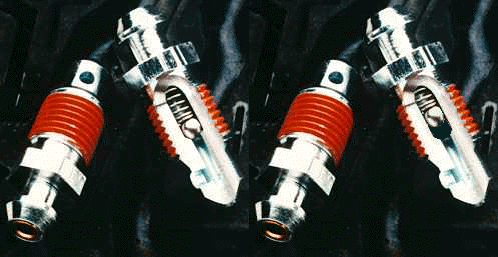
SETUP #4:
Finally, there are times when NONE of the above techniques may satisfactorily bleed all air bubbles from the brake system. (For example, when the reservoir is allowed to run dry, or when new brake lines are installed, or when the master cylinder is rebuilt.) The normal bleeding technique may not move a sufficient amount of fluid quickly enough to expel the air. The best setup I have heard of for these situations is something like the MityVac Brake Bleeding Kit 6820 (click on photo for more info):

Whew! That's going to have to do it for now. I gotta get to bed! I'll try to get pictures of SETUP #1 soon. I need to replace my brake fluid anyway.... :)
Title: brake help
Post by: danci1973 on August 06, 2004, 04:32:11 AM
Post by: danci1973 on August 06, 2004, 04:32:11 AM
More about brake fluids (what are the diffs between DOTx):
http://www.vtr.org/maintain/brake-fluids.html...
D.
http://www.vtr.org/maintain/brake-fluids.html...
D.
Title: brake help
Post by: dgyver on August 06, 2004, 05:31:03 AM
Post by: dgyver on August 06, 2004, 05:31:03 AM
If the system is not leaking, the reason the reservoir level is low is due to pad wear. Better check your pads.
Title: brake help
Post by: Dorianfes on August 06, 2004, 08:38:34 AM
Post by: Dorianfes on August 06, 2004, 08:38:34 AM
thanks for the help guys. kerry, i appreciate the long write up, i'll try on of those set-ups this weekend. and dgyver, i'll be sure to check my pads, chances are they need to be replaced
Title: brake help
Post by: cernunos on August 06, 2004, 01:40:45 PM
Post by: cernunos on August 06, 2004, 01:40:45 PM
Dorianfes, remember to put the resevoir cap back on during bleeding cycles as the fluid in the resevoir can "jump" up and out when you squeeze the brake lever. Just stickin' my nose in. But I love the little bike and I love the forum too.
C.......
C.......
Title: Re: brake help
Post by: tucsondude on August 06, 2010, 06:22:10 PM
Post by: tucsondude on August 06, 2010, 06:22:10 PM
to anyone who is nervous about bleeding their brakes, it is incredibly easy. Just did it the first time, took like 20 min. 1 hour if you include tools, beer break, cleanup, admiring your bike.
sportbiketrackgear, has a great youtube video on this.
Yes i know old res, figured this was a good thread rather than making a new one
tools on the cheap:
8mm wrench
phillips screw driver
container
2' of <1/4" clear vinyl tubing
edit: make sure to properly dispose of old fluids.
sportbiketrackgear, has a great youtube video on this.
Yes i know old res, figured this was a good thread rather than making a new one
tools on the cheap:
8mm wrench
phillips screw driver
container
2' of <1/4" clear vinyl tubing
edit: make sure to properly dispose of old fluids.
Title: Re: brake help
Post by: burning1 on August 06, 2010, 07:09:00 PM
Post by: burning1 on August 06, 2010, 07:09:00 PM
No no no NO NO NO NO.
Unless there is something seriously wrong with your braking system, you should never need to 'top off' your brake fluid. The brake fluid level drops as your brake pads wear down and the pistons extend further out of the calipers. So long as your brake system is maintained properly, you should never need to add fluid - merely inspect the pads, and perform your routine bleed & flush.
If the fluid *is* low, it's a strong indicator that you're due for new pads. Inspect the pads, replace them. Once the pads are replaced, flush the brake fluid (assuming you're due for it) and check the level. Make sure the fluid level does not go above the 'maximum' line. The extra space at the top of the reservoir is important, and there is no benefit in adding more fluid than necessary.
Unless there is something seriously wrong with your braking system, you should never need to 'top off' your brake fluid. The brake fluid level drops as your brake pads wear down and the pistons extend further out of the calipers. So long as your brake system is maintained properly, you should never need to add fluid - merely inspect the pads, and perform your routine bleed & flush.
If the fluid *is* low, it's a strong indicator that you're due for new pads. Inspect the pads, replace them. Once the pads are replaced, flush the brake fluid (assuming you're due for it) and check the level. Make sure the fluid level does not go above the 'maximum' line. The extra space at the top of the reservoir is important, and there is no benefit in adding more fluid than necessary.
Title: Re: brake help
Post by: burning1 on August 06, 2010, 07:10:42 PM
Post by: burning1 on August 06, 2010, 07:10:42 PM
Also, bleeding the brakes is not hard, but I would not describe it as easy. If improperly done, the process can compromise or potentially lead to a total failure of the front brakes.
It helps to have an experienced friend available the first time you perform the procedure.
It helps to have an experienced friend available the first time you perform the procedure.
Title: Re: brake help
Post by: Shaddow on August 06, 2010, 10:40:28 PM
Post by: Shaddow on August 06, 2010, 10:40:28 PM
Those speed bleed nipples are unreal. They have just gone on my must have shopping list. The project car gets them first though. It will be eating pads quicker then the bike anyway.